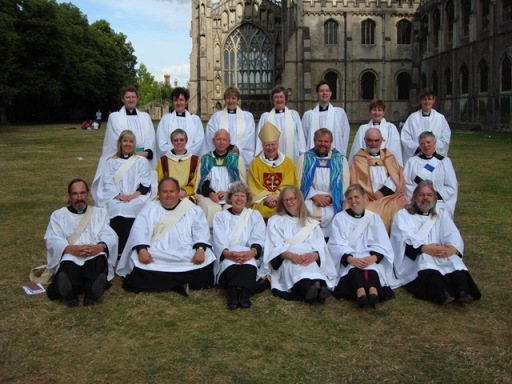
New deacons have been ordained in the Episcopal Diocese of Massachusetts, on June 5 & 6. Because of current public health circumstances due to COVID19, the ordinations have taken place in a new way this year. The Liturgy of the Word portion of the ordination service, including presentation of the ordinands and sermon by Bishop Alan M. Gates, was conducted as an online gathering via Zoom on Friday, June 5 at 7 p.m. The examination and laying on of hands for the ordinands took place at separate events at the Cathedral Church of St. Paul in Boston on Saturday, June 6. Only the primary participants were able to be present in person, to accommodate physical distancing protocols. Family members, friends, sponsors and the wider diocesan community watched via live webcast.
Of the nine ordained, four were ordained to the diaconate: Marilee Comerford (Trinity Church, Marshfield); Valerie Cowart (All Saints’ Church, Chelmsford); James Thomas (St. John’s Church, Sandwich); and Natalie Thomas (St. Christopher’s Church, Chatham). (The other five were ordained to the transitional Diaconate, a step towards priesthood, in separate online services).

Those ordained to the diaconate chose to be ordained together, serving as each other's supporters, a wonderful affirmation of their sense of community and belonging in the diaconate.
Blessings to Marilee, Valerie, James and Natalie on their ordination.

Natalie's morning prayer on the day of her ordination (published on her Facebook page)
God, make me worthy of the ministry you have entrusted to me.
I want to stand in the gap – a reminder of injustice, suffering, and pain in the church and a sign of love, endurance, and promise in the world.
I want to love the gap.
I want to remember that church and world are more wrapped up than we ever know.
I want to love the things that are uncomfortable,
help me make my home in the questions that aren’t easily answered.
Help me to push myself and the people who seek to follow you to be discontent
with what feels good enough and to push on towards your way of wholeness.
Help me to remain, to remain steady for those who cannot feel you in the moment.
Help me to remember that you show up to all of us in our own ways
and in our own time and all I am called to do, is love.
Help me to forgive, over and over and over again,
to remember that I get to choose what I hold on to and what I release.
Help me to believe in who you have called me to be.
Help me to run your race with all you have given me,
please God give me glimpses of you along the way.
Help me to stay grounded in your truth – remind me that I am dependent on your love
and without your guidance and your word, the word, as my light and lamp, I will falter.
Hold me when I don’t think I’m held.
Keep me humble, aware that I never know the full picture,
remind me that you are bigger than any of us can understand,
keep my ears open to year ever active truth.
Anger me and embolden me when our world doesn’t look like what you imagined for us –
stir up in me a longing for equity, justice,
and liberation that cannot be diminished by worldly comforts
May I go to places where I can be among those who know your way,
the way of exclusion and suffering.
Remind me that you lived your life among those the world deemed sick –
help me do the same.
May this ministry transform and challenge me.
Every. Single. Day.
Most of all, may I always remember that this is not my path to carve out, you have gone ahead, Holy Spirit, Miriam, Mary, Sarah, Hagar, Bathsheba, Mary Magdalene, Sedonia, Phoebe, Elaine, Dorothy, Annette, Sojourner, Rosa, Barbara, Pat, Esther … the Spirit has gone ahead and I am never ever ever alone on this path.
It's a prayer that we can all pray!
Of the nine ordained, four were ordained to the diaconate: Marilee Comerford (Trinity Church, Marshfield); Valerie Cowart (All Saints’ Church, Chelmsford); James Thomas (St. John’s Church, Sandwich); and Natalie Thomas (St. Christopher’s Church, Chatham). (The other five were ordained to the transitional Diaconate, a step towards priesthood, in separate online services).

Those ordained to the diaconate chose to be ordained together, serving as each other's supporters, a wonderful affirmation of their sense of community and belonging in the diaconate.
Blessings to Marilee, Valerie, James and Natalie on their ordination.
 |
| newly ordained Deacon Natalie Thomas |

Natalie's morning prayer on the day of her ordination (published on her Facebook page)
God, make me worthy of the ministry you have entrusted to me.
I want to stand in the gap – a reminder of injustice, suffering, and pain in the church and a sign of love, endurance, and promise in the world.
I want to love the gap.
I want to remember that church and world are more wrapped up than we ever know.
I want to love the things that are uncomfortable,
help me make my home in the questions that aren’t easily answered.
Help me to push myself and the people who seek to follow you to be discontent
with what feels good enough and to push on towards your way of wholeness.
Help me to remain, to remain steady for those who cannot feel you in the moment.
Help me to remember that you show up to all of us in our own ways
and in our own time and all I am called to do, is love.
Help me to forgive, over and over and over again,
to remember that I get to choose what I hold on to and what I release.
Help me to believe in who you have called me to be.
Help me to run your race with all you have given me,
please God give me glimpses of you along the way.
Help me to stay grounded in your truth – remind me that I am dependent on your love
and without your guidance and your word, the word, as my light and lamp, I will falter.
Hold me when I don’t think I’m held.
Keep me humble, aware that I never know the full picture,
remind me that you are bigger than any of us can understand,
keep my ears open to year ever active truth.
Anger me and embolden me when our world doesn’t look like what you imagined for us –
stir up in me a longing for equity, justice,
and liberation that cannot be diminished by worldly comforts
May I go to places where I can be among those who know your way,
the way of exclusion and suffering.
Remind me that you lived your life among those the world deemed sick –
help me do the same.
May this ministry transform and challenge me.
Every. Single. Day.
Most of all, may I always remember that this is not my path to carve out, you have gone ahead, Holy Spirit, Miriam, Mary, Sarah, Hagar, Bathsheba, Mary Magdalene, Sedonia, Phoebe, Elaine, Dorothy, Annette, Sojourner, Rosa, Barbara, Pat, Esther … the Spirit has gone ahead and I am never ever ever alone on this path.
It's a prayer that we can all pray!