Followers

Showing posts with label Lutheran. Show all posts

Saturday, August 13, 2016

New 'Worship and Service roster' in ELCA

Deaconess Louise Williams
preaching at ELCA Churchwide Assembly, August 2016
A recommendations on ‘One Roster of Word and Service’ was presented to the ELCA Churchwide Assembly. In essence, the Assembly was asked to consider a recommendation to transition the three current rosters of Word and Service – Associate in Ministry, Deaconess, and Diaconal Minister – into one, new, unified roster of Word and Service, to be called Deacon. This recommendation has been many years in the making, and Louise Williams (past-President, DIAKONIA World Federation) has served on the ELCA task forces and teams that crafted it. 
Louise reports: 'The great news is that the ‘Word and Service roster’ passed overwhelmingly at the Assembly. Deaconesses, associates in ministry and diaconal ministers received a rousing ovation'.

(You can watch a video of the voting process for this recommendation here, starting at 17.50. I love the voting machines - very innovative)

(You can watch a video of Louise Williams' preaching at the ELCA Churchwide Assembly here). 

Saturday, June 7, 2014

Ben Ema's consecration as Lutheran Deacon

In 2011, the Lutheran Deaconess Association Board of Directors voted to accept men into the LDA's diaconate. Ben Ema has been serving as the first President of the Community of Lutheran Deacons (CLD) which includes men who are deacons or deacon students.

Ben by profession is a nursing student at Valparaiso University. He has now completed his requirements for formation to be a Lutheran Deacon, and his consecration service will be on Sunday June 8th in the afternoon, to be held at the Chapel of the Resurrection at Valparaiso University, 1600 Chapel Drive, Valparaiso, Indiana.

This is a very exciting time for Ben, and historically a very significant time as Ben will be the first Lutheran Deacon (through the LDA) to be consecrated.

Congratulations, Ben! 

(If you wish to send a greeting to congratulate Ben, perhaps you can communicate via Lisa Polito (Executive Director, LDA) or via the Facebook World DIAKONIA page)

Deacon Students 2013
Ben Ema (centre back) with other students - Elliott Stephenson, Steve Arnold, Andrew Stoebig, and Jack Walter
         
Rev Bill Loader has several 'charges' for new Deacons in the Uniting Church in Australia. This one is adapted for Ben. 

You have become a member of an order which has taken many forms over the course of the church’s life.
Like all ministries it finds its origin and its life in the ministry of Jesus Christ.
All are called to ministry.
All are called to share God’s life in the world, whether in formal acts of worship or hands-on actions of care.
All orders of ministry which have been put in place in the church to make this possible participate in this same wide range of ministry.
They vary in the focus and intensity of their activities rather than in their range.
As a Deacon your primary focus will be offering leadership in this wide range of ministry as it expresses itself in acts of caring service in the world. You will do more than this, but this is the concentration that belongs especially to your order.
To engage in leadership includes leadership by example.
You will pray for people.
You will care for people.
You will bring to people in word and deed the good news of hope and love.
To engage in leadership also includes teaching.
You will dream dreams and see visions and tell what you have seen.
You will help people understand how to care, what they are caring about and why.
You will help people make connections between themselves and their faith and their world.
To engage in leadership also includes prophecy and protest.
You will not only see the poor, but identify the structures which create and sustain poverty.
You will not only see injustices, but identify the powers at work whose interests are served by injustice.
You will not only comfort the broken-hearted, but cry out to God with them in the impenetrable darkness where no answers are ever visible.
When the sands blow and the dry winds buffet you, stand firm,
As you have stood firm before.
The buds that have long been forming will wait their time
And then the colour will come
And you will surprise yourself again with beauty and strength.
Sink your roots deeply,
for new seasons await you,
new fruit to form, new seeds to spread,
borne by the naturalness of your spirituality.
Don't be afraid to penetrate deeply into the rich soil of scripture beneath the surface mulch
which keeps it warm and makes it look nice;
People need depth and you can give it to them.
At times you will hum with insects, flies, and bees
and kweech with squawking birds.
Enjoy the buzz and challenge of ministry,
but treasure also the times of silent renewal.

For you are not asked to carry the world on your shoulders.
You are not to be held accountable for every human need.
There will be times when you must close your eyes, not in denial, but because you can only see so much.
There are times when you must rest, not in carelessness, but in deliberate nurture of your own being.
You do not have to do everything, so you can be free to face human need without the trickeries of denial and without the self indulgence of despair.
Such freedom from yourself will mean you will be best available to others.
You will be free to affirm joy and to affirm pain
and to be yourself and bear fruit in ministry.


Sunday, May 11, 2014

Ted Dodds reflection on the course, Diaconal History and Spirituality

In January 2014, Rev (Deac) Dr Ted Dodd attended a course on Diaconal History and Spirituality at the Lutheran Theological Southern Seminary in Columbia, South Carolina.  It is SO GREAT to see the exchange of learning happening across and between denominations. It would be great to see more intentionality in these kind of exchanges, be they learning opportunities or ministry placements or observation.
Here are Ted’s reflections on the event…
ted_dodd“I chose this course because I wanted to consolidate my understanding of the two thousand years of diaconal history. While I do not claim to be an expert, I now feel that I have a rich understanding of the significant eras in the timeline of the diaconate.
Through the centuries, this ministry has taken on a variety of forms and functions. No one definition of diakonia stands as decisive or irrefutable. No single model delineates diaconal ministry finally or categorically. Over the ages, the diaconate has moved with flexibility into areas where they are needed, where service is required. Further, diaconal ministry is more than an office or the people who were called deacons or deaconesses; the whole church is called to diakonia.
While I do not believe history needs to be seen through a deterministic lens, I do feel that we are shaped by the past. The diaconal story begins before one is commissioned, consecrated, or ordained, and one is moulded by it, often without knowing the details or without articulating its assumptions. I deeply valued this opportunity to learn who we are by studying the past. Immersing myself in the content of our diaconal tradition offered me a broader comprehension of my vocation and will enable me to share this knowledge and insight with our students.
A second goal of the course was to ground the process of diaconal discernment and formation in spiritual practice. We read texts related to community: Brother Roger and the TaizĂ© community, and Dietrich Bonhoeffer’s classic work, Life Together. We participated in daily public worship, kept journals, and entered into a private, daily lectio divina reading of the Psalms. Additionally, we studied an excellent short history of Christian spirituality, Bradley Holt’s Thirsty for God.

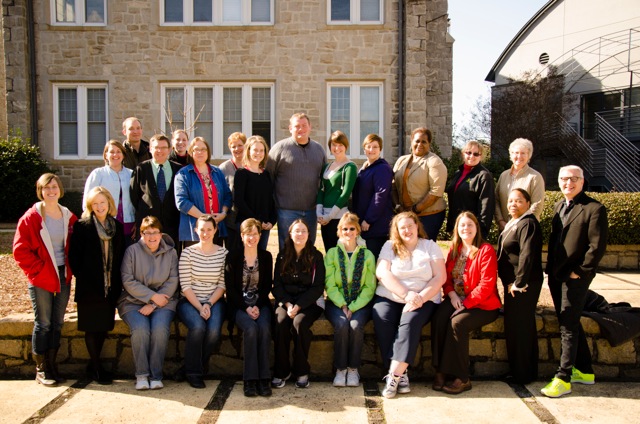
participants in the Lutheran diaconal ministry course in South Carolina
Ted at far right with the neon yellow shoes, at the Diaconal Ministry Course in South Carolina
Being immersed in the Lutheran culture for a week proved to be very rewarding. My sense of their theology and values grew exponentially. I delved into their rosters of ministry, various denominational documents and core writings, and some of their divisions and theological influences. As well, this experience offered me the chance to visit in an area of the US where I have not really been connected previously. I ate barbeque and biscuits, collards and fried green tomatoes. One evening we were invited to attend “Beer and Hymns” at a local pub. The bar was packed with Southerners singing songs of faith in what would normally be a very secular setting; I had read about such endeavours of the emerging church; I was happy to witness such an initiative in person. On the weekends bracketing the course, I visited Savannah and Charlotte and managed to see four art galleries, a historic plantation, a restored mansion, and the Museum of the New South. I watched the Martin Luther King, Jr. Parade, attended a service at First African Baptist Church, and also went to a Centre for Afro-American culture. This exposure intensified my commitment to diversity and broadened my perspective.

'Virtual' Online conferences

It's very interesting to see the way that technology has enabled 'virtual' online conferences/seminars. Here are two that may be of interest, all from the comfort of home.

Women Deacons: Past, Present, Future
(* this is a Catholic initiative, but much of the discussion will be relevant to other denominations)
Date
: June 9-July 8, 2014
Organisation: Hofstra University
Instructors: Gary Macy, William T. Ditewig, Phyllis Zagano, all noted researchers and authors of articles and books on the women's diaconate.
Resources: Participants will need 2 books (available on Kindle as well as through Amazon - see below)
Course outline: During the seminar, the first four days of each week will contain readings and lectures (about an hour's worth of work per day). Each Friday, the Discussion Board will open for three days. Where possible an instructor or a teaching assistant will join in. The seminar will consider questions related to past, present, and future during the discussion:
1. In the past: Who were the women deacons in the early church? Were they ordained? What did they do? Why did they disappear?
2. In the present: When was the diaconate rejuvenated, and why? Has there been consideration of women in the diaconate?
3. In the future: What are the obstacles to women in the diaconate? How can these challenges be addressed? What would it mean for women to be ordained?

To register, follow the instructions here. It's FREE.

http://people.hofstra.edu/phyllis_zagano/images/Vagaggini.jpg
Ordination of Women to the Diaconate in the Eastern Churches: Essays by Cipriano Vagaggini
http://ir-na.amazon-adsystem.com/e/ir?t=phylzagahofsu-20&l=as2&o=1&a=081468310X Collegeville, MN, Liturgical Press, 2013.
http://people.hofstra.edu/phyllis_zagano/images/Womendeacons-Past-Present-Future.gif
Women Deacons: Past, Present, Future.
http://ir-na.amazon-adsystem.com/e/ir?t=phylzagahofsu-20&l=as2&o=1&a=0809147432
(With Gary Macy and William T. Ditewig) Mahwah, NJ: Paulist Press, 2011.


Lutheran World Federation
Once again, the LWF (Department for Mission and Development) is planning a 'virtual conference'. It was brilliant in 2013, and I would encourage you to check it out. It will be held on 18th September, 2014 and will again feature highly diverse speakers, be accessible in five languages (English, Spanish, German, French and Indonesian) and have engaging conversations. More detailed information will be available towards the end of June 2014.