Followers

Saturday, May 30, 2015

Episcopal Deacons blogging

Deacons who blog.....
Interested to peruse these blogs by Deacons in the Episcopal Church in the USA.
Betsy Blake Bennett, Archdeacon, Diocese of Nebraska
Alisa Carmichael, Diocese of South West Florida
Bill Cusano, Diocese of New York
Betty J. Kauffman, Archdeacon, Diocese of Western Louisiana
Kevin McGrane Sr, Diocese of Missouri
Rodger Patience, Diocese of Fond du Lac
Geri Swanson, Diocese of New York

Who else out there is blogging? Would love to make connections!


Qatar and human rights

I have followed the story about the FIFA arrests this week. As Edwin Rios writes: On Wednesday, the US Department of Justice dropped the hammer on FIFA, the world governing body of soccer, indicting nine senior FIFA officials and five sports marketing execs on charges of corruption, wire fraud, racketeering, and money laundering. Allegations of bribery have long plagued FIFA, especially since its controversial decision to grant Qatar the 2022 World Cup. (The decision to award the 2022 World Cup to the rich Gulf state with a terrible human rights record was a controversial one right out of the gate. There have been extensive allegations of bribery: why else, some figured, award the Cup to a tiny country with sweltering summer heat and no soccer culture to speak of?)
The discovery of oil in the 1940s and the discovery of natural gas in the 1970s has transformed Qatar. Fifteen years ago, the country was in debt. Now Qatar is the richest nation in the world per capita. Construction and development are exploding.
And there is a great need for workers in the construction boom, and to build the stadium for the World Cup. But for foreign workers, mainly from Nepal, India, Sri Lanka, Bangladesh and the Philippines, the situation is dire. Since 2010, more than 1,200 migrant workers have died in Qatar under hazardous working conditions, and a 2013 Guardian investigation found that at least 4,000 total are projected to die before the 2022 World Cup even starts. Nepali workers weren't even allowed to return home after the country's recent devastating earthquake. Christopher Ingraham at the Washington Post put that toll in perspective in a striking infographic. He compared the number of workers who died in the run-up to several Olympics and World Cups with the number of those who have died in Qatar so far. It's horrifying:

The Guardian reports that workers are dying but have no opportunity to leave their appalling work conditions. They have often borrowed money to travel to Qatar from work (between $600-$5000, with interest at 30-60% per annum!), and then the salaries they are given in Qatar are far less than they had been told. Some have had their salaries delayed by months, some for more than a year. The migrant workers are tied to their employers for the length of their contract which can be five years. Amnesty continues to campaign on behalf of the workers.

I am moved by the plight of these workers who simply seek a way to provide their families back home with a way to a brighter future. Sporting events must not be built on the backs of the poor and vulnerable, and in ways that enslave them. It should be a concern not only for sports lovers, but for all people with regard for human life, and the flourishing of human dignity.


Pray that God will use this time of world focus to expose the evil and bring changes that will improve the conditions under which workers are forced to operate. Pray for justice and lasting transformation in Qatar for the lives of its migrant workers.


Monday, May 25, 2015

Eurovision and Australia


Australia had a wildcard entry in the 60th Eurovision Song Contest 2015 - which is surprising, given that Australia is 'down under' and nowhere near Europe! I was up early to watch the grand final live in Austria (not to be confused with Australia) and to cheer on the Australian contestant, Guy Sebastian. Australia finished 5th in the 2015 Eurovision Song Contest, receiving 196 points including the top votes from the host nation Austria and the competition winners Sweden.
 
I love the fact that the face of Australia at Eurovision, Guy Sebastian, was born in Malaysia from a cultural background of a Portugese/English mother brought up in India, and a Sri Lankan father from Malaysia, and that the Australian results were beamed in by Australian newsreader Lee Lin Chin, Indonesian-born of Chinese descent. I love the fact that they represent Australia at its best as a vibrant, multicultural nation
 
It was interesting to reflect on Pentecost in light of all these different nations belting out their music (too many power ballads, in my humble opinion!). It was interesting to reflect on the Pentecost story, and that there is no one divine language, but that God’s Spirit was revealed in multiple languages. That all languages are holy and equally worthy of carrying God's stories. That multi-culturalism and multi-lingualism are intrinsically interwoven into the fabric of God's church on earth.  There's much to celebrate in that, and much that presents a challenge to us all. About how we make space for difference, and how we learn to orient our ears to different languages. About how we respect the boundless variety and creativity of human voices. About the way powerful first world countries can use language as a weapon and restrict languages of other peoples in order to oppress and eliminate those perceived as different or threatening.

"We should listen carefully to the gospel — the good news — of Pentecost. On that day when God moved in fiery inspiration, God gave the divine voice to all the languages, to the marginalized, to the street. Any time a language or a voice crying out is suppressed, it is God’s voice, too, we are attempting to silence. We might do well to participate in Pentecost with this in mind, listening for the voice of God among the silenced, the powerless, the ignored, the forgotten, the oppressed, the nobodies.Pentecost wasn’t just about evocative images of fiery tongues and a rushing wind. Pentecost was a rebellion against those that would seek to restrict God to a single, respectable or official language of a single, righteous people or a single, systematic theology. Pentecost was a protest in which God refused to be silenced by the language of the powerful. Instead, on Pentecost, God spoke. And the people in the streets understood. They spoke, too, in the tongues of angels, the divine voice. Nothing could have been more subversive". David Henson, Patheos
 
And maybe it's worth a look at some of the Eurovision songs. While Australia's contribution was a great R&B 'get up and dance' song, some country’s songs contained political messages, some subtle, some more blatant. Greece's One Last Breath, was supposedly about divorce but mirrored its current economic brinkmanship with European creditors. Armenia’s group Genealogy was forced to change the name of its song Don’t Deny to Face the Shadow, as it was considered too provocative in this 100th anniversary year of the Armenian genocide. It purports to be about universal values and that happiness is born when people are united and live in harmony. Romania's song is All over again. The official music video shows a young boy whose parents are working in Vienna. Visibly sad at his parents being away, he writes letters to them begging them to come home and even dreams of sailing all the way up the Danube to find them. Towards the end of the video, this message appears on-screen:“More than 3 million Romanians are working abroad, trying to make a better life for their children. Unfortunately, the children are left behind.” In an age where economic downturn has hit hard across Europe and such sacrifices are a very real part of people’s daily lives, the song is unique in that it expresses the feelings surrounding this social phenomenon.

Russia's contribution was a beautiful anthemic and hopeful song, A million voices.

We are the world's people
Different yet we're the same
We believe, we believe in a dream

Praying for peace and healing
I hope we can start again
We believe, we believe in a dream

So if you ever feel love is fading
Together like the stars in the sky
We can sing, we can shine

Chorus:
When you hear our voices call
You won't be lonely anymore
A million voices
Your heart is like a beating drum
Burning brighter than the sun
A million voices


Now as the world is listening
From cities and satellites
We believe, we believe, in a dream

If you ever feel love is fading
Together like the stars in the sky
We can sing, we can shine

Chorus:

Bridge:
When I look around at these faces
I can see the stars in the sky
We will sing, we will shine

Singing out, Singing out..... a million voices.....


Friday, May 22, 2015

Archbishop Oscar Romero (1917-1980) to be beatified May 23rd, 2015


Hundreds of thousands of people are expected to fill the streets of the capital of El Salvador on Saturday 23rd May to celebrate as former Archbishop Oscar Romero is beatified.
The following is from Shane Claiborne's Facebook page:

 
Archbishop Oscar Romero was killed 35 years ago on March 24th - as he served communion during worship. Many of the soldiers responsible for the atrocities in El Salvador like this one were trained by the US Army in Fort Benning, GA. Now Romero is on the path to sainthood as an official martyr of the church.
Although he began as a conservative archbishop, opposed to the progressive liberation theology that was popular among those seeking to help poor farmers in El Salvador, Oscar Romero was changed when his friend, a priest, was assassinated as a result of commitment to social justice.
Through weekly homilies on national radio, Romero advocated an end to the repression of the people in El Salvador, thus making himself an enemy of the government and the military. He was not successful in ending the violence: more than 75,000 Salvadorans would eventually be killed, one million would leave the country, and another million would be left homeless.
Because of his prophetic witness, Romero became a target of assassination. As he was saying Mass on March 24, 1980, he was shot and killed. “A bishop will die,” Romero had said, foreseeing his own fate, “but the church of God—the people—will not perish.”
At his funeral, the army opened fired on the more than 100,000 mourners, killing dozens.

Tuesday, May 19, 2015

Celebrating 60 years of diaconal ministry - Sr Irene Brunsveld

Sister Irene Brunsveld
On April 30th, 2015, Sister Irene Brunsveld celebrated 60 years as a deaconess. She was born in Bocholt, Germany. When she was 15, she heard a sermon about God prompting Abram to leave his home and move to a new country. That appealed to her enormously. From that moment on, she wanted to put her life at the service of God. Being only 15, her parents thought she was too young for such a drastic choice. But a long conversation one evening made them realize how serious young Irene was about what she felt God was calling her to do. She was only 16 when she completed a diaconal year in a supportive environment, and had the opportunity to learn to speak the Dutch language. In her ministry, she was available for young and old, healthy and sick, rich and poor. She was a kindergarten teacher, youth worker, and worked in several centres for the elderly, and nursing home aged care. She was able to open up faith conversations about with people, including terminally ill patients.
Sister Irene has always related her ministry to a watering can: Just as a watering can keeps plants alive, so she wants to water those experiencing difficult times with her love, kindness and compassion - where there is need, to be present with hands and heart. 'This is only possible if we receive and remain connected to the source of living water'.
Now 76, Sister Irene is far from silent, or 'retiring'. She does a lot of pastoral care. She makes visits to people in Amerongen. She has an extensive network of acquaintances, and visits the retired sisters who live in Elim. As she looks back on her years of diaconal service, she reflects: 'It's been worth it. I've had a rich life, and enjoy every day of God's faithfulness and good care'.

Sister Irene is part of the DWF member association, Zendings-Diaconessenhuis Bethanie

Zendings Diaconessenhuis
We celebrate Sister Irene's life, her witness and service, and her courage to respond to and pursue God's call on her life. We give thanks for her ministry, and her example of practical care and compassion - 'a watering can' for all those who thirst in life. And in celebrating Sister Irene's life, we are reminded of the iconic figure of Abram who left his country and kin in response to God's call on his life, and we recognize again the faithful of every generation and expand our awareness of a great company of witnesses above and around us like a cloud (Hebrews 12:1). Such awareness lifts us out of a preoccupation with our own immediate situation and the discouragements of the present. In the knowledge that others have persevered, we are encouraged to endure against all odds (Hebrews 12:1-2). And we are reminded that God has been with the faithful of the past, and so we are reassured that God is with us today. Thanks be to God!

Saturday, May 16, 2015

Adnyamathanha pilgrimage

Look, listen, there are no straight lines....
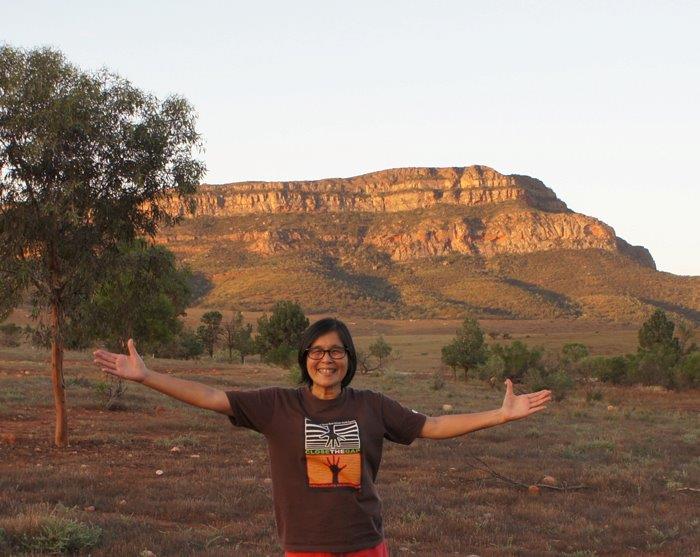
DSC00789 for web
Sophie Lizares
In February 2015, Deacon candidate Sophie Lizares and Aboriginal Pastor Denise Champion, also a candidate for Ministry of Deacon in the Uniting Church in Australia, shared time together in the Flinders Ranges, about 5 hours north of Adelaide in South Australia.

This is Sophie's story:
“You asked about how to approach Aboriginal people,” Aunty Denise Champion picks up our conversation from several days ago. “This is how,” she says as together we step onto a path leading  to a low circular monument.
Nothing would have kept me from walking directly to the sinuous rust stone carving that mimicked the two snakes of Ikara (Wilpena Pound), the vast geological monument that surrounds us.  There were no barriers, no instructions, no protocols, just a stone marker at the mouth of the path announcing, “Ngarlparlaru yata”.

https://revivemagdotorg.files.wordpress.com/2015/04/dsc00921-web.jpg

“This is our country,” Denise translates as we walk the two-toned gravel walk that wound its way to the centre. In the Aboriginal world, nothing is direct, the subtleties confound.
I am saved by the saying ‘relationship before stories before questions’, a way so counter-intuitive to the journalist in me. At the brown centre of the monument, however, on a grim grid, no words were minced:
“We lost our traditional way of life to pastoralism and our land to pastoralism–and adapted to an alien culture, a new language and religion.”
“My dad couldn’t vote, he was under the Dog Act. I felt so bad.”
“If the missionaries heard us kids speaking our language, they would refuse to sell our mother groceries at the store. She would have to wait for the next week  or travel to the next town to buy flour and sugar.”
“After years of pastoral settlement, our traditional life has disappeared.”

Embedded on the ground are crosses, horseshoes, and a length of barbed wire that cuts across. Even for me, it is painful, the line between prison and freedom. For all the Adnyamathanha place names that Aunty Denise had earlier asked us to remember – Vandha Urthanha, Yura Bila, Ngurri Madlanha – she gives us no name for this memorial. She refers to it as the ‘National Park Rangers Quarters' - in English.

Aunty Denise, a Uniting Aboriginal and Islander Christian Congress elder, is leading a pilgrimage of about 30 persons on Adnyamathanha country, 430kms north of Adelaide. There are whitefellas and blackfellas, but when one looks closely, the lines blur. There is Rhanee whose mother is Aboriginal and whose father came from Indian, Malay and Anglo lines. With her is her American-born husband, who traces his genealogy to Costa Rica and to Africans who were taken there. Their children are dusky blonde beauties. There are the three brothers from the Taize  Community, one French, another German, another Australian, their own ‘Pilgrimage of Trust’ intersecting with us: Anglo-Australian, German-Australian, Italian, French, Liberian and Filipino.

Friday, May 15, 2015

Congratulations to Rev Jim Ley on being awarded honorary doctorate


Rev. James Ley to Receive Honorary DoctorateCongratulations to Rev Jim Ley, the Archdeacon from the Episcopal Diocese of Pennsylvania, on being awarded an honorary Doctorate of Public Service at Widener University today (May 15th). This is for Jim's work with the people of Chester, PA, one of the most disadvantaged cities in the US. Of the 33,000 population, 36.9% live in poverty and 13.2% are unemployed (compared to national average of 7%).
Jim has been involved in operating non-profit organizations in the Chester area, including establishing America's first non-profit supermarket, Fare and Square. 
Jim recognized his call to ordained ministry as part of his involvement in Chester Eastside Inc. (formally known as Chester Eastside Ministries). He was ordained in 2003 and the following year was appointed as the Archdeacon of the Episcopal Diocese of Pennsylvania. He is currently the vice chair of Chester Eastside Inc. and president of the advisory board of Episcopal Place at Park Row, a low income housing project in Upland, Pa. He is a member of the Chester branch of the NAACP and the Chester Swarthmore Leadership Institute. In his 18 years of social justice advocacy, he has been associated with more than a dozen other organizations in Chester and the Episcopal Diocese and was the recipient of the John Shelton Sr. Freedom Award given to the Chester branch of the NAACP and the Liberty Bell Award given by the Delaware County Bar Association.
He also works very closely with Widener on the Community Based Learning Strategic Planning Taskforce, The Bonner High Impact Strategic Planning Committee, The Presidents Community Advisory Board and frequently guest lectures and provides administration, professors and students tours of Chester as seen through the lens of social justice.
Widener University, will award the honorary doctorate, is a metropolitan university that connects curricula to social issues through civic engagement. Widener President James T. Harris III. “Rev Ley’s commitment to the community and social justice is an inspiration for all of us and a value that we strive to instill in our students before they graduate.”
33,000 - Population of Chester
36.9 - Percentage of Chester residents living in poverty
13.2 - Percentage of unemployed residents
- See more at: http://webcache.googleusercontent.com/search?q=cache:NuXcgDqghtgJ:articles.philly.com/2013-09-27/news/42430182_1_food-desert-philabundance-first-nonprofit-supermarket+&cd=3&hl=en&ct=clnk&gl=us#sthash.OZAUNWeC.dpuf